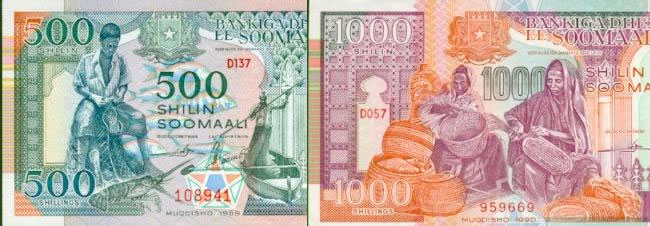
It is actually the total opposite.
I dont think its fair to suggest that the Somali currency has totally lost its confidence. Its just that the folks back home would rather use the US currency, especially for larger transactions for obvious reasons (you dont want to carry a bucket full of money to buy an expensive item). This is a currency in fact that has been widely used in some areas of Somaliland, particularly Burco up until last year (it is no longer used there due to government involvement of getting rid of it. It had to do with the case of sovereignty and independence rather than the case of it being a worthless currency not worthy of being used).
In order to have confidence in a currency, you have to have trust in it. Yes it may be counterfeit but the next street vendor or even the money exchange business are willing to accept it because it is in the end of the day an accepted currency. If it wasn't accepted, it would have been totally shunned.
USE of a paper currency is normally taken to be an expression of faith in the government that issues it. Once the solvency of the issuer is in doubt, anyone holding its notes will quickly try to trade them in for dollars, jewellery or, failing that, some commodity with enduring value (when the rouble collapsed in 1998 some factory workers in Russia were paid in pickles). The Somali shilling, now entering its second decade with no real government or monetary authority to speak of, is a splendid exception to this rule.
Why, then, are Somali shillings, issued in the name of a government that ceased to exist long ago and backed by no reserves of any kind, still in use?
One reason may be that the supply of shillings has remained fairly fixed. Rival warlords issued their own shillings for a while and there are a fair number of fakes in circulation. But the lack of an official printing press able to expand the money supply has given the pre-1992 shilling a certain cachet. Even the forgeries do it the honour of declaring they were printed before the central bank collapsed: implausibly crisp red 1,000-shilling notes, with their basket weavers on the front and orderly docks on the back, declare they were printed in the capital in 1990.
A second reason for the shilling’s longevity is that it is too useful to do away with. Large transactions, such as the purchase of a house, a car, or even livestock are dollarised. But Somalis need small change with which to buy tea, sugar, qat (a herbal stimulant) and so on.
The shilling has a further source of strength. Since each party to a transaction is likely to be able to place the other within Somalia’s system of kinship, the shilling is underpinned by a strong social glue. Paper currencies always need tacit consent from their users that they will exchange bills for actual stuff. But in Somalia this pact is rather stronger: an individual who flouts the system risks jeopardising trust in both himself and his clan.
Retrieved:
http://www.economist.com/node/21551492