



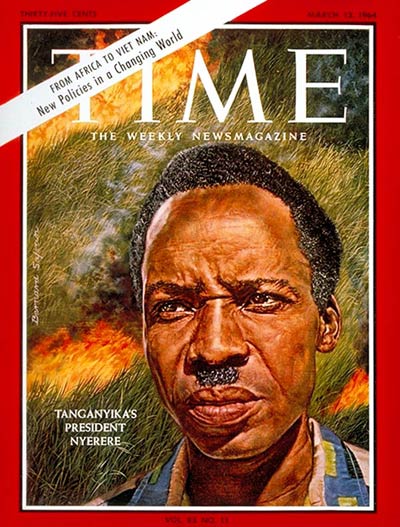
Mwalimu Julius Kambarage Nyerere
ulius Kambarage Nyerere was one of Africa's leading independence heroes (and a leading light behind the creation of the Organization of African Unity), the architect of ujamaa (an African socialist philosophy which revolutionized Tanzania's agricultural system), the prime minister of an independent Tanganyika, and the first president of Tanzania.
Date of Birth: March 1922, Butiama, Tanganyika
Date of death: 14 October 1999, London, UK
An Early Life
Kambarage ("the spirit which gives rain") Nyerere was born to Chief Burito Nyerere of the Zanaki (a small ethnic group in northern Tanganyika) and and his fifth (out of 22) wife Mgaya Wanyang'ombe. Nyerere attended a local primary mission school, transferring in 1937 to Tabora Secondary School, a Roman Catholic mission and one of the few secondary schools open to Africans at that time. He was baptized a catholic on 23 December 1943, and took the baptismal name Julius.
Nationalistic Awareness
Between 1943 and 1945 Nyererre attended Makerere University, in Uganda's capital Kampala, obtaining a teaching certificate. It was around this time that he took his first steps towards a political career -- in 1945 he formed Tanganyika's first student group, an offshoot of the African Association, AA, (a pan-African group first formed by Tanganyika's educated elite in Dar es Salaam, in 1929). Nyerere and his colleagues began the process of converting the AA towards a nationalistic political group.
Once he had gained his teaching certificate, Nyerere returned to Tanganyika to take up a teaching post at Saint Mary's, a Catholic mission school in Tabora. He opened a local branch of the AA, and was instrumental in converting the AA from its pan-African idealism to the pursuit of Tanganyikan independence. To this end, the AA restyled itself in 1948 as the Tanganyika African Association, TAA.
Gaining a Wider Perspective
In 1949 Nyerere left Tanganyika to study for an MA in economics and history at the University of Edinburgh. He was the first African from Tanganyika to study at a British university and, in 1952, was the first Tanganyikan to gain a degree. At Edinburgh Nyerere became involved with the Fabian Colonial Bureau (a non-Marxist, anti-colonial socialist movement based in London). He watched intently Ghana's path to self-government, and was aware of the debates in Britain on the development of a Central African Federation (to be formed from a union of North and South Rhodesia and Nyasaland). Three years of study in the UK gave Nyerere an opportunity to vastly widen his perspective of pan-African issues. Graduating in 1952, he returned to teach at a Catholic school near Dar es Salaam. On 24 January he married primary school teacher Maria Gabriel Majige.
Developing the Independence Struggle in Tanganyika
This was a period of upheaval in west and south Africa -- in neighboring Kenya the Mau Mau uprising was fighting against white settler rule, and nationalistic reaction was rising against the creation of the Central African Federation. But political awareness in Tanganyika was nowhere near as advanced as with its neighbors. Nyerere, who had become president of the TAA in April 1953, realized that a focus for African nationalism amongst the population was needed. To that end, in July 1954, Nyerere converted the TAA into Tanganyika's first political party -- the Tanganyikan African National Union, or TANU.
Nyerere was careful to promote nationalistic ideals without encouraging the kind of violence that was erupting in Kenya under the Mau Mau uprising. TANU manifesto was for independence on the basis of non-violent, multi-ethnic politics, and the promotion of social and political harmony. Nyerere was appointed to Tanganyika's Legislative Council (the Legco) in 1954. He gave up teaching the following year to pursue his career in politics.
International Statesman
Nyerere testified on behalf of TANU to the UN Trusteeship Council (committee on trusts and non-self-governing territories), in both 1955 and 1956. He presented the case for setting a timetable for Tanganyikan independence (this being one of the specified aims set down for a UN trust territory). The publicity he gained back in Tanganyika established him as the country's leading nationalist. In 1957 he resigned from the Tanganyikan Legislative Council in protest over the slow progress independence.
TANU contested the 1958 elections, winning 28 of 30 elected positions in the Legco. This was countered, however, by 34 posts which were appointed by the British authorities -- there was no way for TANU to gain a majority. But TANU was making headway, and Nyerere told his people that "Independence will follow as surely as the tickbirds follow the rhino." Finally with the election in August 1960, after changes to the Legislative Assembly were passed, TANU gained the majority it sought -- 70 out of 71 seats. Nyerere became chief minister on 2 September 1960 and Tanganyika gained limited self-government.
Independence
In May 1961 Nyerere became prime minister, and on 9 December Tanganyika gained its independence. On 22 January 1962, Nyerere resigned from the premiership to concentrate on drawing up a republican constitution and to prepare TANU for government rather than liberation. On 9 December 1962 Nyerere was elected president of the new Republic of Tanganyika.
Nyerere's Approach to Government #1
Nyerere approached his presidency with a particularly African stance. First he attempted to integrate into African politics the traditional style of African decision making (what is known as "indaba in Southern Africa). Consensus is gained through a series of meetings in which everyone has an opportunity to say their piece. To help build national unity he adopted Kiswahili as the national language, making it the only medium of instruction and education. Tanganyika became on of the few African countries with an indigenous official national language. Nyerere also expressed a fear that multiple parties, as seen in Europe and the US, would lead to ethnic conflict in Tanganyika
Political Tensions
In 1963 tensions on the neighboring island of Zanzibar started to impact on Tanganyika. Zanzibar had been a British protectorate, but on 10 December 1963, independence was gained as a Sultinate (under Jamshid ibn Abd Allah) within the Commonwealth of Nations. A coup on 12 January 1964 overthrew the sultanate and established a new republic. Africans and Arabs were in conflict, and the aggression spread to the mainland -- the Tanganyikan army mutinied.
Nyerere went into hiding and was forced to ask Britain for military assistance. He set about strengthening his political control of both TANU and the country -- in 1963 he established a one-party state (which lasted until 1 July 1992), outlawed strikes and created a centralized administration. A one-party state would allow collaboration and unity without any suppression of opposing views he stated. TANU was now the only legal political party in Tanganyika. Once order was restored Nyerere announced the merger of Zanzibar with Tanganyika as a new nation; the United Republic of Tanganyika and Zanzibar came into being on 26 April 1964 with Nyerere as president. The country was renamed the Republic of Tanzania on 29 October 1964.
Nyerere's Approach to Government #2
Nyerere was reelected president of Tanzania in 1965 (and would be returned for another three successive five year terms before resigning as president in 1985). His next step was to promote his system of African socialism, and on 5 February 1967 he presented the Arusha Declaration which set out his political and economic agenda. The Arusha Declaration was incorporated in to TANU's constitution later that year.
The central core of the Arusha Declaration was ujamma, Nyerere's take on an egalitarian socialist society based on cooperative agriculture. (The policy was influential throughout the continent, but it ultimately proved to be flawed.) Ujamaa is a Swahili word which means community or familyhood. Nyerere's ujamaa was a program of independent self-help which supposedly would keep Tanzania from becoming dependant on foreign aid. It emphasized economic cooperation, racial/tribal, and moralistic self-sacrifice.
By the early 1970s a program of villagization was slowly organizing rural life into village collectives. Initially voluntary, the process met with increasing resistance, and in 1975 Nyerere introduced forced villagization. Almost 80% of the population ended up organized into 7,700 villages. Ujamaa emphasized the country's need to be self-sufficient economically rather than being dependent on foreign aid and foreign investment. Nyerere also set up mass literacy campaigns, and provided free and universal education. In 1971, he introduced state ownership for banks, nationalized plantations and property. In January 1977 he merged TANU and Zanzibar's Afro-Shirazi Party into a new national party - the Chama Cha Mapinduzi (CCM, Revolutionary State Party).
Despite a great deal of planning and organization, agricultural production declined over the 70s, and by the 1980s, with falling world commodity prices (especially for coffee and sisal), its meager export base disappeared and Tanzania became the largest per-capita recipient of foreign aid in Africa.
Nyerere on the International Stage
Nyerere was a leading force behind the modern Pan-African movement, a leading figure in African politics in the 1970s, and was one of the founders of the Organization of African Unity, OAU, (now the African Union). He was committed to supporting liberation movements in Southern Africa and was a forceful critic of the Apartheid regime of South Africa (chairing a group of five frontline presidents who advocated the overthrow of white supremacists in South Africa, South West Africa, and Zimbabwe). Tanzania became a favored venue for liberation army training camps and political offices. Sanctuary was given to members of South Africa's African National Congress, as well as similar groups from Zimbabwe, Mozambique, Angola and Uganda. As a strong supporter of the Commonwealth of Nations, Nyerere helped engineer South Africa's exclusion on the basis of its Apartheid policies.
When President Idi Amin of Uganda announced the deportation of all Asians, Nyerere denounced his administration. When Ugandan troops occupied a small border area of Tanzania in 1978 Nyerere pledged to bring the downfall of Amin. In 1979 20,000 troops from the Tanzanian army invaded Uganda to aid Ugandan rebels under the leadership of Yoweri Museveni. Amin fled into exile, and Milton Obote, a good friend of Nyerere, and the president Idi Amin had deposed back in 1971, was placed back in power. The economic cost to Tanzania of the incursion into Uganda was devastating, and Tanzania was unable to recover.
The End of an Influential Presidency
In 1985 Nyerere stepped down from the presidency, in favor of Ali Hassan Mwinyi. But he refused to give up power completely, remaining leader of the CCM. When Mwinyi started to dismantle ujamaa, and to privatize the economy, Nyerere ran interference. He spoke out against what he saw as too much reliance on international trade and the use of gross domestic product as the main measure of Tanzania's success.
At the time of his departure, Tanzania was one of the world's poorest countries. Agriculture has reduced to subsistence levels, transportation networks were fractured, and industry was crippled. At least one third of the national budget was provided by foreign aid. On the positive side, Tanzania had Africa's highest literacy rate (90%), had halved infant mortality, and was politically stable.
In 1990 Nyerere gave up leadership of the CCM, finally admitting that some of his policies hadn't been successful. Tanzania held multiparty elections for the first time in 1995.
Julius Kambarage Nyerere died on 14 October 1999 in London, UK, of leukaemia. Despite his failed policies, Nyerere remains a deeply respect figure both in Tanzania and Africa as a whole. He is referred to by his honorific title mwalimu (a Swahili word meaning teacher).