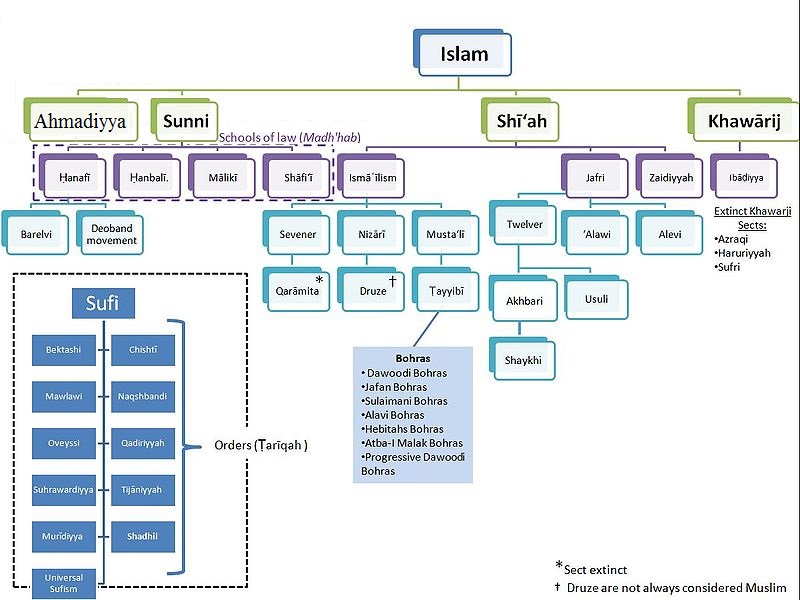




Narrated AbuHurayrah: The Prophet (peace_be_upon_him) said: The Jews were split up into seventy-one or seventy-two sects; and the Christians were split up into seventy one or seventy-two sects; and my community will be split up into seventy-three sects. (Abu dawud, Model Behavior of the Prophet (Kitab Al-Sunnah) [40:4579] )

http://upload.wikimedia.org/wikipedia/c ... m_tree.jpg
Ash'ari
Ash'ari is a school of early Islamic philosophy founded in the 10th century. It was instrumental in drastically changing the direction of Islam and laid the groundwork to "shut the door of ijtihad" centuries later in the Ottoman Empire.[citation needed] The Asharite view was that comprehension of the unique nature and characteristics of God were beyond human capability.
Athari
The Athari is a school that derives its name from the Arabic word Athar, meaning "Narrations". The Athari methodology is to avoid delving into extensive theological speculation. They use the Qur'an, the Sunnah, and sayings of the Sahaba. Athari is generally synonymous with Salafi.
Twelver
Twelvers believe in twelve Imams. The twelfth Imam is believed to be in occultation, and will appear again just before the Qiyamah (Islamic view of the Last Judgment). The Shi`a Hadiths include the sayings of the Imams. Many Muslims criticise the Shia for certain beliefs and practices, including practices such as the Mourning of Muharram (Mätam). They are the largest Shi'a school of thought (85%), predominant in Azerbaijan, Iran, Iraq, Lebanon and Bahrain and have a significant population in Pakistan, Kuwait and the Eastern province of Saudi Arabia. The Twelver Shi'a are followers of the Jaf'ari madh'hab.
Kharijite
Kharijite (lit. "those who seceded") is a general term embracing a variety of Muslim sects which, while originally supporting the Caliphate of Ali, eventually seceded after his son Imam Hasan negotiated with Mu'awiya during the 7th Century Islamic civil war (First Fitna). Their complaint was that the Imam must be spiritually pure, and that Hasan's compromise with Mu'awiya was a compromise of his spiritual purity, and therefore of his legitimacy as Imam or Caliph. While there are few remaining Kharijite or Kharijite-related groups, the term is sometimes used to denote Muslims who refuse to compromise with those with whom they disagree.
Sufism
Sufism is a mystical-ascetic form of Islam. By focusing on the more spiritual aspects of religion, Sufis strive to obtain direct experience of God by making use of "intuitive and emotional faculties" that one must be trained to use.[25] Sufis usually considered Sufism to be complementary to orthodox Islam, however it has often been accused of being an unjustified Bid‘ah or religious innovation by the Salafi. One starts with sharia (Islamic law), the exoteric or mundane practice of Islam and then is initiated into the mystical (esoteric path of a Tariqah (Sufi Order).[citation needed] Some Sufi followers consider themselves as Sunni or Shi'a, while others consider themselves as simply 'Sufi' or Sufi-influenced
Qadiri, Qadiriyyah
The Qadiri Order is one of the oldest Sufi Orders. It derives its name from Abdul-Qadir Gilani (1077-1166), a native of the Iranian province of Gīlān
my question is which sect you belong to ?? and how do you know you're on the right path with so many sects ,madhhabs ,branches and school of thought thoughts out there ?
i personally don't belong to any of the sects mentioned , i view myself as a Muslim only i follow the Quraan and Sunaah , if i need any info or say have a question about the Diin i talk/search/look to all different shiekhs/madhhabs/schools put my faith in God then i pick what makes sense, Allah gave us brain to think and decide not blindly follow others


 Allahu Qafuuron raxiim