

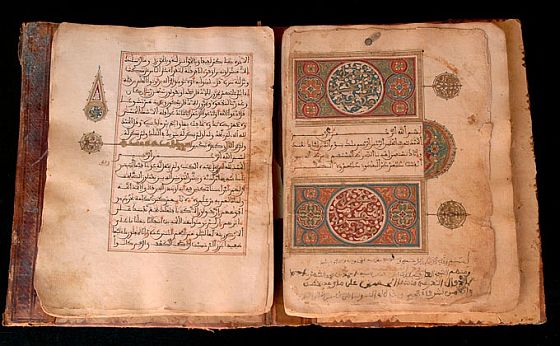
^A copy of the Koran from the 12th century. According to notes in the text, it was bought for a Moroccan king for a sum of gold.

Pictured here is Abdel Kader Haidara , one of Timbuktu’s leading manuscripts experts and son of a deceased renown local scholar, Mama Haïdara. In front of Haïdara in a glass case is a Koran, with, on the lower part of the image, a note indicating that several kings of Morocco owned it. The writing is typically Moroccan 12th century.

This manuscript from the Mamma Haidara Commemorative Library explains the history of the Sharifians and their geneology

This manuscript of an astrology treatise dating back to 1144 in the Hegira can be found at the Mamma Haidara Commemorative Library.

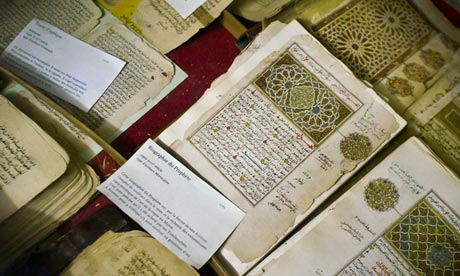
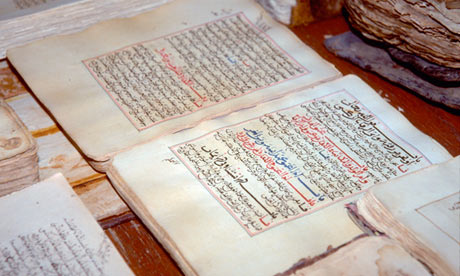
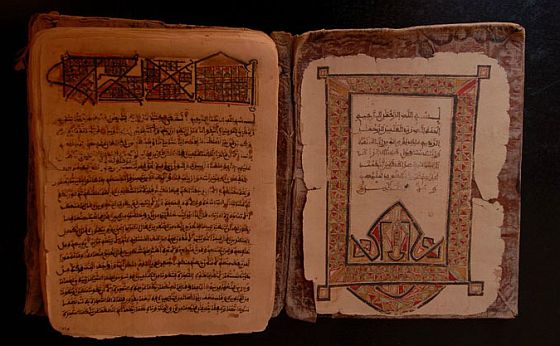

Timbuktu was a world centre of Islamic learning from the 13th to the 17th century, especially under the Mali Empire and Askia Mohammad I's rule. Knowledge was gathered in a manner similar to the early, informal European Medieval university model. Lecturing was presented through a range of informal institutions called madrasahs. Nowadays dubbed the ‘University of Timbuktu’, three madrasahs facilitated 25,000 students: Djinguereber, Sidi Yahya and Sankore.

Today, by the so called "Helpers of the Religion" (Ansar al Diin), before their cowardly flight from Timbuktu, they decided to burn whatever of the collections of manuscripts, qurans, and books they could find. Setting fire to the great libraries of Timbuktu.