Forum rules
This General Forum is for general discussions from daily chitchat to more serious discussions among Somalinet Forums members. Please do not use it as your Personal Message center (PM). If you want to contact a particular person or a group of people, please use the PM feature. If you want to contact the moderators, pls PM them. If you insist leaving a public message for the mods or other members, it will be deleted.
Eruptions create new islands in the Red Sea
Two volcanic bodies formed in 2011 and 2013
BY THOMAS SUMNER
11:58AM, JUNE 2, 2015
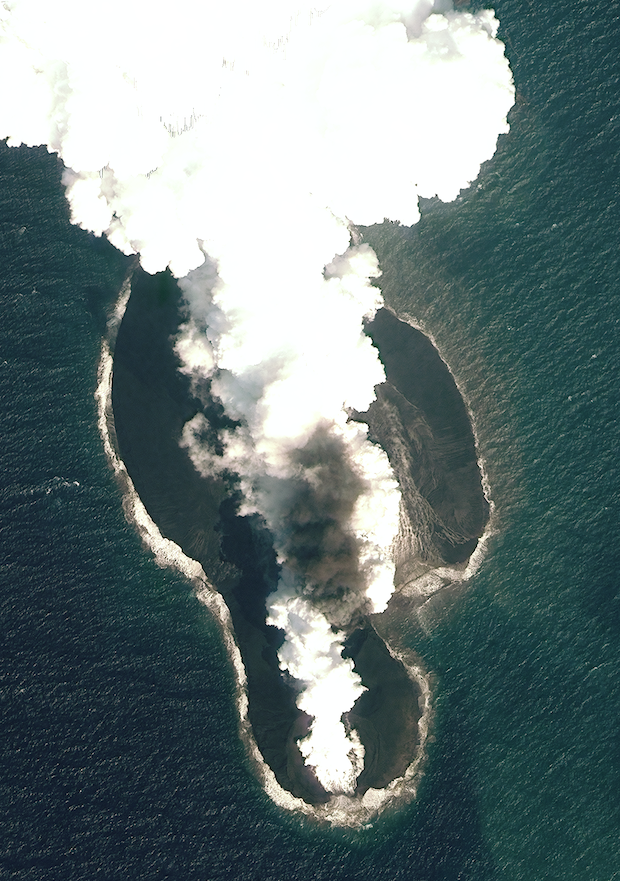
NEWFOUND LAND Two new volcanic islands cropped up in the Red Sea (Jadid Island formed during the eruption seen in this satellite image). The isles, roughly the size of a few dozen football fields, will help scientists better understand how islands get shaped.
Update your maps: Two new islands have popped up in the strip of ocean between Africa and the Arabian Peninsula.
Witnessing the birth of a volcanic island is incredibly rare, but thanks to satellite images, researchers from the King Abdullah University of Science and Technology in Thuwal, Saudi Arabia, retraced the formation of two islands in the Red Sea.
The new islands, called Sholan and Jadid, formed where two tectonic plates pull apart at a rate of about 6 millimeters a year. Magma burst through cracks in Earth’s crust during weeks-long eruptions, piling up rock and creating the new isles, one in 2011–2012 and the other in 2013. The larger island, Jadid, is about one-fifth the size of New York’s Central Park, the researchers report online May 26 in Nature Communications. Anyone wanting to take advantage of the new seaside real estate should act fast: Erosion has already shrunk Sholan Island by about 30 percent.
Editor's Note: This story was updated June 4, 2015, to correct the photo's labeling. Originally, one of the labeled islands was not one of the newly formed isles; now the two new islands are the ones labeled.
Eruptions create new islands in the Red Sea | Science News
Two new volcanic islands emerge in Red Sea
This satellite image shows the first volcanic island that formed in December 2011 in the Red Sea near Yemen.
NASA IMAGE BY ROBERT SIMMON, USING ALI DATA FROM THE EO-1 TEAM.
The islands named Sholan and Jadid formed in what is known as the Zubair archipelago near Yemen in the southern Red Sea. They formed in 2001 and 2013. They grew quite quickly after forming but have since shrunk over time due to erosion, according to a study published in Nature Communications that used high-resolution satellite imagery to study their changing size over time.
Sholan Island - located between Haycock and Rugged islands - grew out of an eruption that lasted 25 days starting in December 2011. It reached a size of .52 kilometers wide and 0.77 kilometers long before shrinking 30 percent over the past two years. Wind and ocean currents also played a role in its size, according to the study, with the island growing the north in the winter and spring while deposits move back from the northern shore to the southern part of the island during the summer.
Jadid Island formed two years later between Saba and Saddle islands. The eruption lasted 54 days, forming a circular island about 0.9 kilometers in size. It, too, shrunk over time due to erosion, with the island reduced to 0.67 kilometers by February 2014.
It isn't a surprise that earthquake activity was found, since the Red Sea has been known to be seismically active for decades. But the emergence of the two islands, according to the study, would suggest the presence of a magmatically active zone that "had previously escaped notice."
The researchers from the King Abdullah University of Science and Technology in Saudi Arabia said these types of underwater eruptions are poorly understood. Few have been witnessed since Surtsey Island emerged south of Iceland in the 1960s.
A satellite photo of the 2011-12 eruption that created Sholan Island. It was taken by the worldview-2 satellite on 23 December 2011.
But based on the persistence of Surtsey, the researchers said they expect these two islands will not disappear anytime soon.
"Similar to Surtsey Island, many of the older and smaller Zubair islands consist of tuff that has not easily eroded away," the researchers wrote. "This is likely also going to be the fate of the new Jadid and Sholan islands, that is, they are going to remain above the surface despite the fast erosion observed immediately after the eruptions."
The appearance of two new volcanic islands in the Zubair archipelago of the southern Red Sea gave researchers from the King Abdullah University of Science and Technology (KAUST) the opportunity to study the rare emergence of new islands on a mid-ocean ridge system1.
Between 2011 and 2013, two volcanic islands, named Sholan and Jadid, appeared in the Zubair archipelago’s mid-ocean ridge system. The eruptions from which they were formed were accompanied by a series of earthquakes, and the seismic and volcanic activity caused visible disturbance to the landscape on neighboring islands.
Sigurjón Jónsson at KAUST’s Earth Science and Engineering Program, recalled hearing of the islands’ formation in December 2011, along with colleagues Wenbin Xu and Joel Ruch. “Given the rarity of such an event, we immediately wanted to learn from it,” Jónsson says.
“However, the islands belong to Yemen and are basically out of reach for fieldwork, so our observations were limited to satellite images and seismic data.”
Xu and Ruch used high-resolution satellite optical and radar imaging techniques to study both how the islands developed as well as how the land deformed on other islands in the archipelago. They detected a previously unrecognized yet significant period of magmatic activity connected with the separation of the African and Arabian continental plates.
Xu used this information to simulate the two eruptions and pinpoint the likely underground triggers for the volcanic activity. Each eruption was fed by a dike — an intrusion of magma pushing towards the surface through existing rock layers. The model suggests both dikes run along a larger, existing North-South fracture system, which cuts through the Zubair area.
“We realized the two eruptions were likely part of a larger sequence of events — a so-called rifting episode,” explains Jónsson. “Rifting episodes occur on boundaries where continental plates are moving apart — a large amount of magma enters the crust from below, and meter-scale spreading of the plates can occur in just a few years. More often than not this happens on the sea floor where it’s almost impossible to study.”
Many decades of limited activity can pass between rifting episodes in any one particular place — the last period of rifting in the southern Red Sea was probably in the 19th century. The recent events present a valuable opportunity to advance understanding of plate divergence, particularly as they are visible on the Earth’s surface.
“We will continue studying this island-building event and its possible influences on future activity in the area,” states Jónsson.
Reference
Xu, W., Ruch, J. & Jónsson, S. Birth of two volcanic islands in the southern Red Sea.Nature Communications 6, 7104 (2015). article
Plate separation births two volcanic islands | KAUST Discovery
Here below one can read a very detailed article about the subject. Published by Nature.
Birth of two volcanic islands in the southern Red Sea : Nature Communications : Nature Publishing Group
Since the volcanic eruptions are taking place in the Red Sea, where we have new islands forming, and Somalia and DJibouti are on the Red Sea, these new seismic and tectonic developments could have an impact on us. Let us hope and pray it won't have catastrophic events associated with them when these plates (African and Arabian) diverge. Keep ind mind all three rift valleys - East African Rift Valley, and "failed" Nugaal and Dharoor rift valleys - can all be affected by these tectonic activities. Any landscape changes on East African Rift Valley will have an effect on Kenya, Ethiopia, and DJibouti (Afar region); whereas any landscape changes on Nugaal and Dharoor valleys will have an effect on Somalia.