




The US will definitely push for the reunion and restoration of Somali Republic but they may offer SL few deals that they can't refuse (take this or be isolated). They may offer self-rule like Kurdistan, huge financial aid but they have to drop secession and come under Mogadishu.
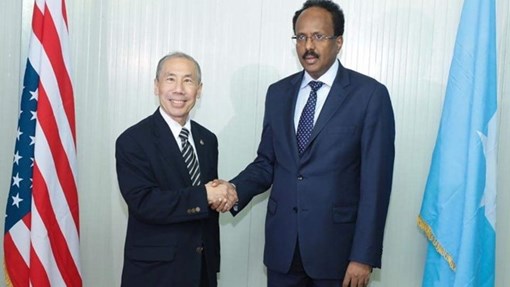
The US wants to roll back the Chinese influence and keep the Russians at bay.
They will invest heavily in Somali Republic and they may ask for the return of Berbera either replacing the UAE or next to them. Well UAE has no good reason to be in the region once Yemen war is put to an end. It looks like it will soon be.
How to Respond to China in Africa
The murder of the Washington Post writer Jamal Khashoggi has finally prompted the leading U.S. media sources to take a hard look at the Yemen War in all its putrid odor. It seems that the killing of a journalist may change the “arc of history,” so perhaps there is a silver lining to Riyadh’s despicable deed. Should the media dare to ask some hard questions about the involvement of the U.S. government and various American corporations in that horrible conflict, they, unfortunately, will have much to discuss. The catastrophe of the Yemen War should be the last nail in the coffin of major U.S. involvement in the Greater Middle East. Before the 1980s, there were no major, permanent U.S. military deployments into the Middle East and Central Asia and America should return to the infinitely wiser and more cautious approach of “offshore balancing.”
In Africa, the mistakes have been smaller, but just as obvious. It was not journalists who were killed, of course, but American servicemen. Andrew Bacevich recently commemorated the brave Americans who died in the bloody 1993 Battle of Mogadishu, suggesting that if we had really grappled fully with the lessons of that tragic day that many subsequent interventions—however, well-intentioned—could have been avoided. Yet, the United States is still stubbornly constructing a large drone facility in Niger a year after four U.S. special forces soldiers were slain in a badly botched “security cooperation” mission nearby. Does anyone think that Niger constitutes a vital interest of the United States? Does anyone actually believe that the drone base in Niger will reduce terrorism in that volatile region rather than increase it? Hopefully, the Niger fiasco will continue to propel a reexamination (and indeed soul searching) regarding U.S. military commitments in Africa. However, a new and disturbing rationale is now increasingly put forward for the enhanced U.S. military footprint in Africa. The justification is—you guessed it—the Chinese bogeyman. To deepen the American understanding of Chinese activities in Africa, this Dragon Eye column will briefly discuss a few recent Chinese-language articles on the subject.
It is indeed true that China is ever more involved in Africa. And that involvement now includes a somewhat extensive security presence. Much has been said about the new Chinese military base in Djibouti. There has been finger-pointing and apparently laser-pointing too. There is the accusation that Chinese observers might gain by watching U.S. Navy ships come in and out of the port. It might occur to those of a less paranoid sensibility that China will be vulnerable to the same kind of snooping (or even laser-pointing if necessary), and moreover that Beijing would not likely set up a base next to several Western countries’ bases if it had something nefarious to hide. Indeed, most of the Chinese military presence in Africa has long been under “blue helmets” as United Nations peacekeepers.As such, Chinese soldiers (mostly engineers, transport experts, police and medical staff) have been sent into some tough situations, from western Morocco to Mali to South Sudan. Not long ago, two Chinese peacekeepers were slain in South Sudan, while another was killed in Mali. A mid-2018 analysis in the Chinese journal International Politics [国际政治] concludes that UN Peacekeeping is plagued by a “leadership ability vacuum [领导力真空]” since America and other Western countries do not take a very active role. “Yet UN peacekeeping has great significance for China [然而, 联合国维和对于中国侧具有非常重要的意义].” The author advocates that Beijing take a stronger leadership stance in UN peacekeeping, and African peace and security building should benefit from “more … effective Chinese planning.”







 )
)